What is the sin of gluttony?
Gluttony is overindulgence in food or drink, and by extension in anything you consume: shows, shopping, scrolling. It is less about the amount than about letting appetite run your life.
Gregory the Great listed five ways to commit it, summed up as eating too soon, too expensively, too much, too eagerly and too daintily. Fussiness counted as much as excess.
Enjoying good food and company is a gift. The sin is when appetite stops serving you and starts steering you.
Signs of gluttony in everyday life
- Eating or drinking past the point of enjoying it.
- Reaching for food, drink or a screen when bored or stressed.
- Planning your day around the next treat.
- Being very particular about only having the best.
- Finishing things because they are there.
Gluttony vs enjoyment
A feast is not gluttony. Not being able to stop is.
Gluttony
Eats or consumes past need and past pleasure, often to fill a feeling. The appetite is in charge.
Enjoyment
Savours good food, drink and company, and is happy to stop. You are in charge of the appetite.
What the Bible says about gluttony
The Bible does not contain the list of seven deadly sins, but it speaks about gluttony directly. These verses are from the King James Version. See the 7 deadly sins in the Bible for the full picture.
“Be not among winebibbers; among riotous eaters of flesh: for the drunkard and the glutton shall come to poverty.”
Proverbs 23:20-21
“Whose end is destruction, whose God is their belly, and whose glory is in their shame.”
Philippians 3:19
“Whether therefore ye eat, or drink, or whatsoever ye do, do all to the glory of God.”
1 Corinthians 10:31
Famous examples of gluttony
Esau’s bowl of stew
In Genesis 25, the hungry Esau sells his birthright to his brother Jacob for a single bowl of lentil stew.
Cerberus in Dante
In Inferno (Canto VI), the gluttonous lie in cold, filthy rain while the three-headed dog Cerberus tears at them.
Augustus Gloop
In Roald Dahl’s Charlie and the Chocolate Factory (1964), the greedy boy falls into the chocolate river he cannot stop drinking from.
The opposite of gluttony: Temperance
Temperance (Temperantia) is the contrary virtue of gluttony. Temperance is moderation: enjoying good things in the right amount, so that you stay in charge of your appetites.
It is one of the seven heavenly virtues, each paired with one of the deadly sins.
Symbols of gluttony
- Animals: Pig. Associations vary between sources; these are the most common in medieval art and later lists.
- Colour: Orange, in the modern colour scheme for the seven sins.
- Demon: Beelzebub, in Peter Binsfeld's 1589 classification. See the 7 demons.
- In Dante: Sixth terrace: the gluttons starve beside trees heavy with fruit they cannot reach.
Gluttony in Bruegel's engraving
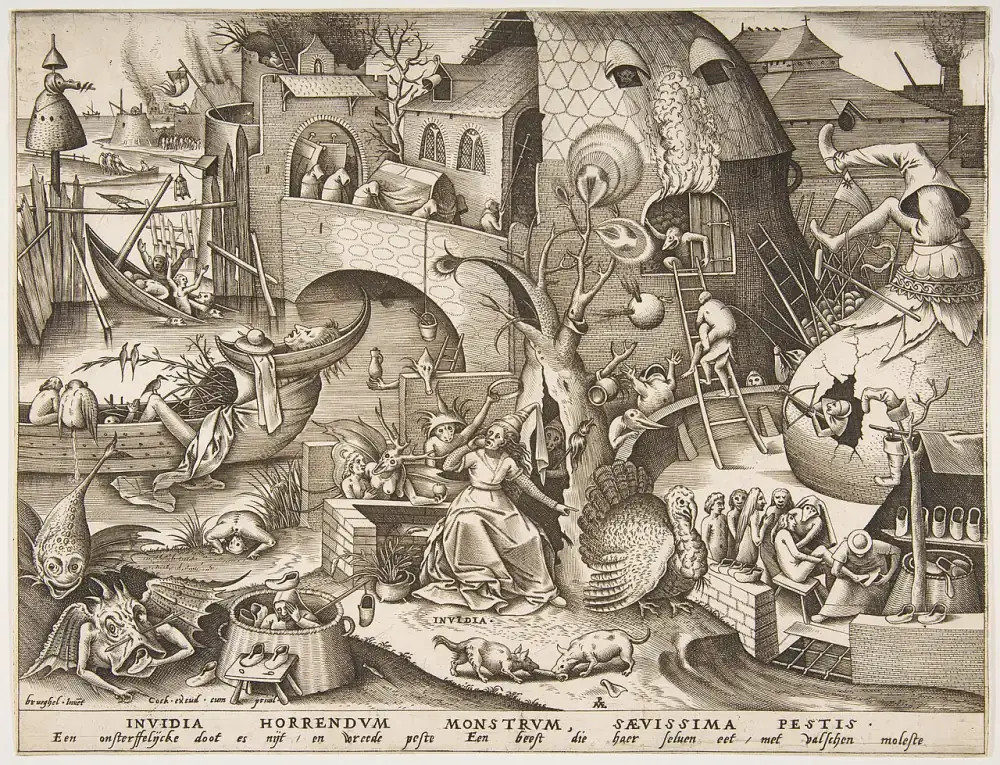
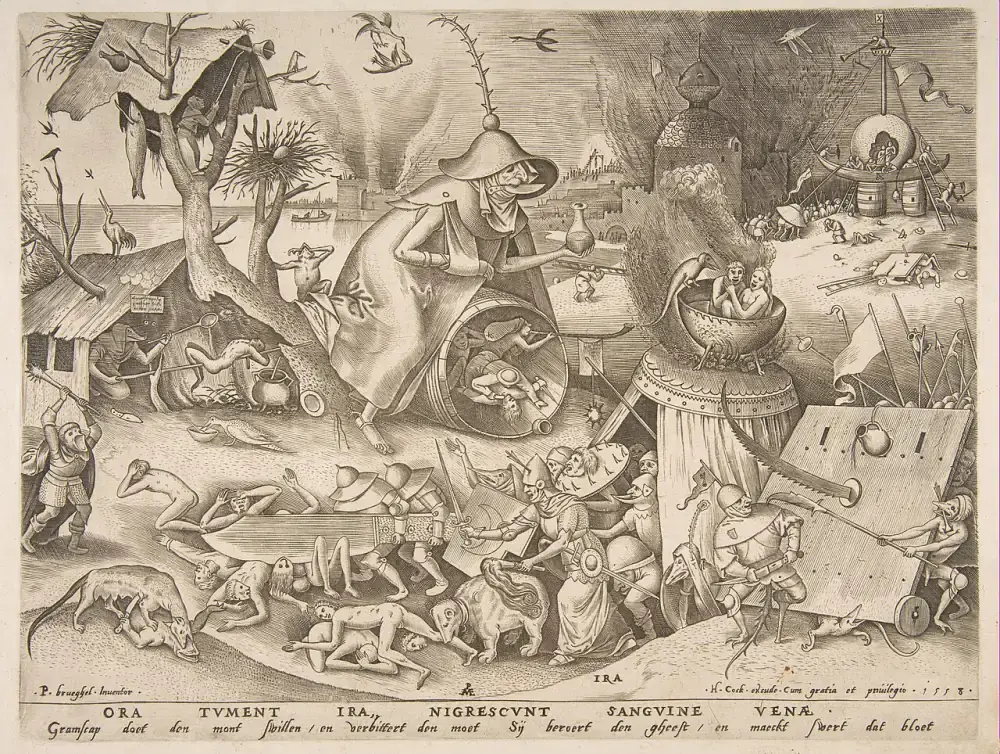
Pieter Bruegel the Elder gave each sin its own crowded print in 1558. Here a woman personifying gluttony stands at the centre, surrounded by figures acting it out.
All seven side by side, with Bosch's painting of the sins: the seven deadly sins in art.
How to work on gluttony
- Eat one meal a day slowly, without a screen.
- Wait ten minutes before a second helping or another episode.
- Notice what feeling you are trying to fill.